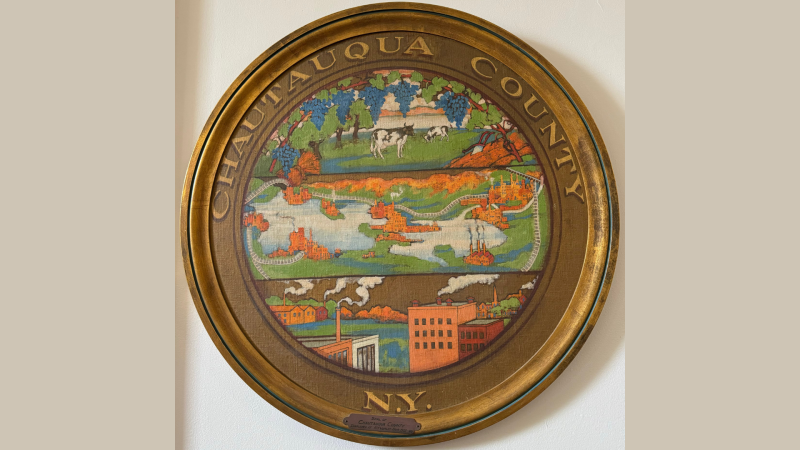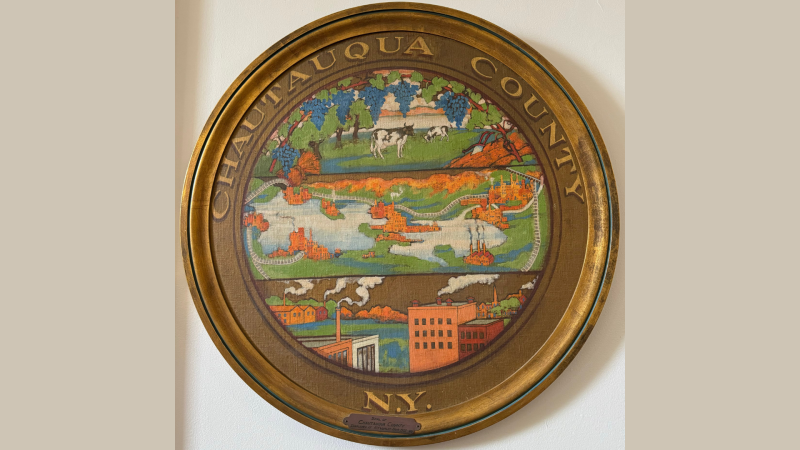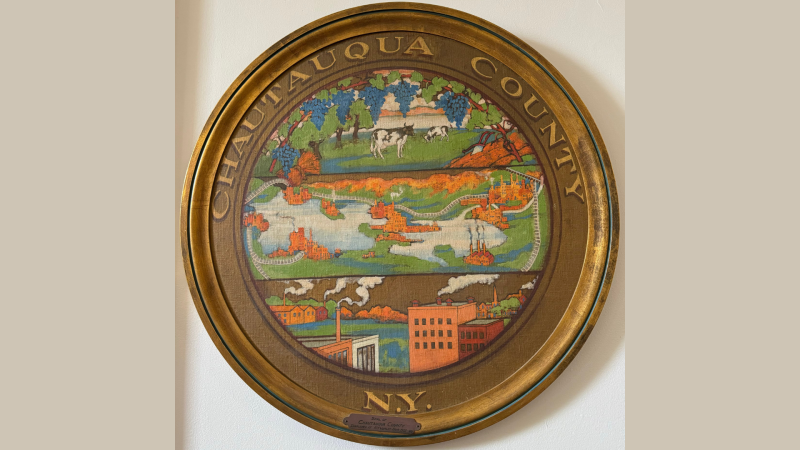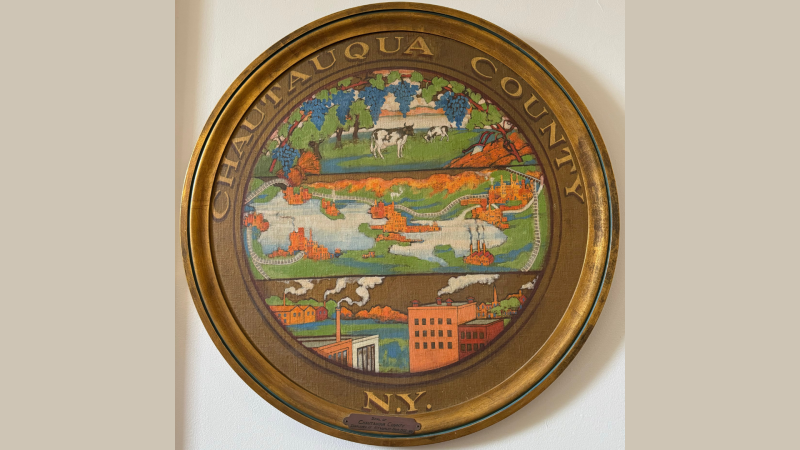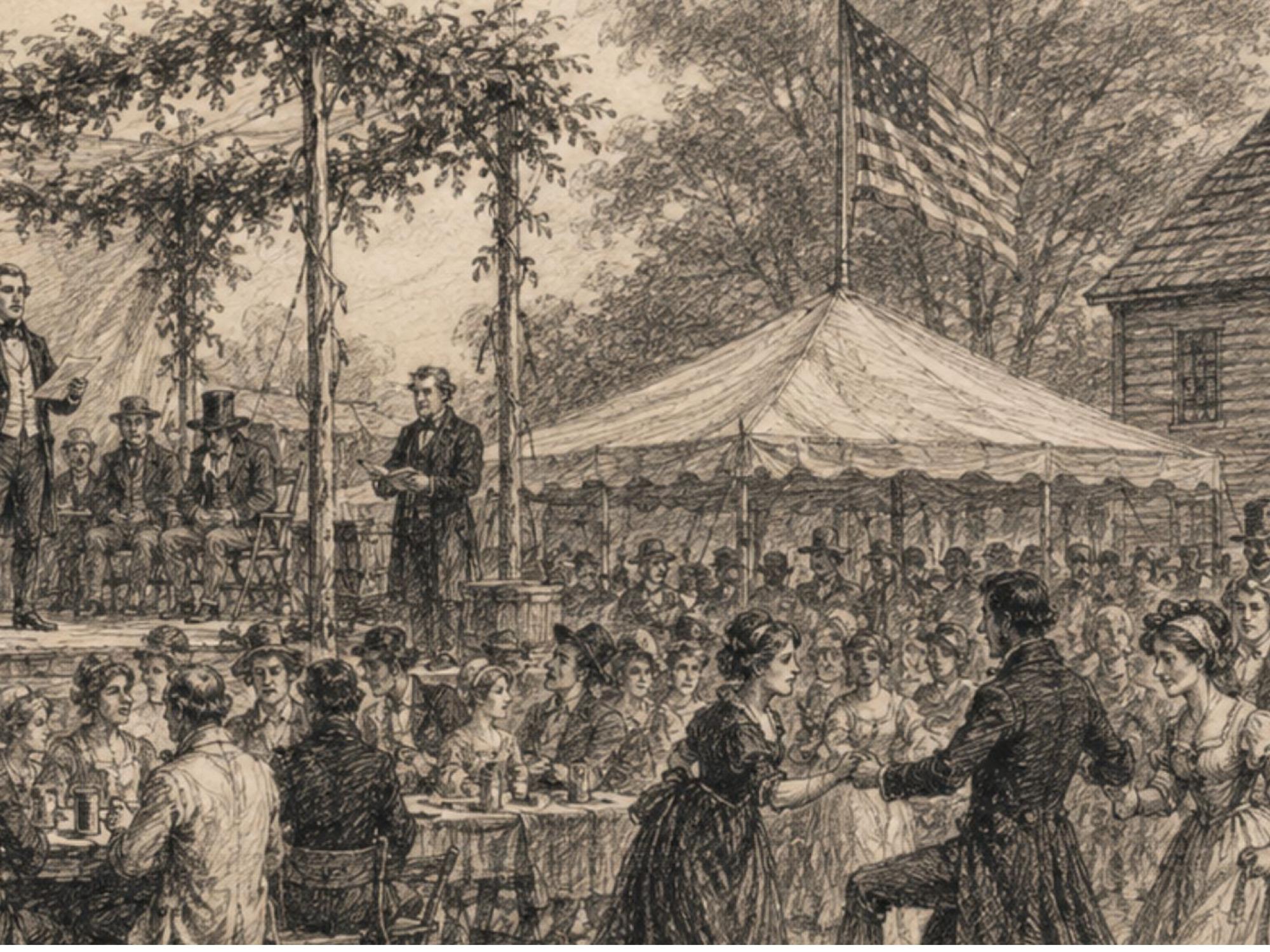
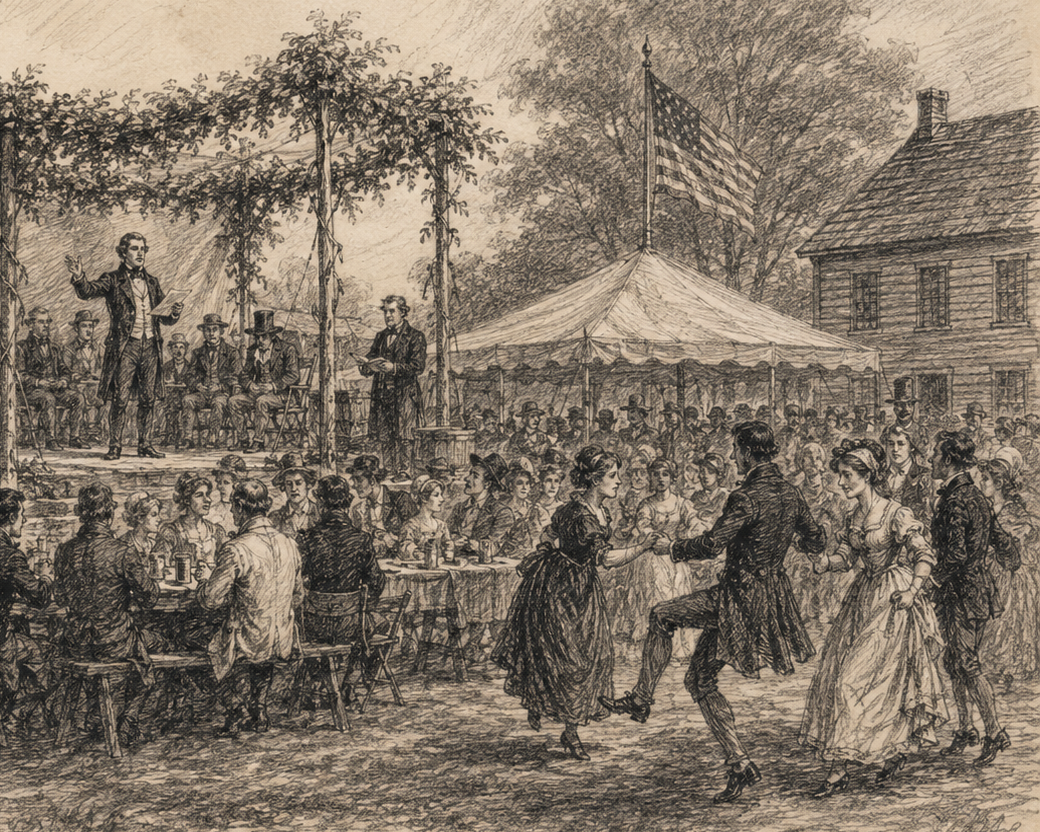
(Illustration (fictional rendering): An artistic interpretation of an Independence Day celebration in Busti, NY, July 4, 1816, depicting a historic gathering with music, dancing, public remarks, and community festivities along Chautauqua County’s early frontier landscape.)
From Young’s History of Chautauqua County, pp. 331–332. Account compiled by County Historian Norman Carlson.
One of Chautauqua County’s earliest Independence Day celebrations is preserved in Young’s History of Chautauqua County under the account known as “The Busti Party,” held July 4, 1816.
Carlson describes it as “a noteworthy celebration of independence in the Town of Ellicott,” held at Stephen Frank’s home in present-day Busti. Though modest in size, the structure had been adapted for the occasion, as “the chamber was finished off for a ball-room, in which there was a ball in the evening.”
He notes the conditions of early travel and daily life: “The day was pleasant, but cool. The roads were bad, and there were no pleasure carriages in the country.” Attendees often arrived on horseback, with “the married men, if they had horses, carried their wives behind them on horseback,” while others came “on foot.”
The gathering reflected both community spirit and political division. Carlson writes that the turnout was “more especially of the democrats,” following a recent local election, and that “the federalists, feeling sore on their defeat, did not enter into the spirit of the celebration.” He adds that “some tried to get up a celebration at Jamestown but failed.”
Formal organization of the day included “Theron Plumb… president of the day, and Levi Leonard, orator,” while “Lemuel Smith of Sugar Grove, Pa., was attending clergyman, and offered prayer.”
Entertainment was simple but memorable. “The only music was the firing of an anvil, and a violin by Ebenezer Davis.” Food and drink reflected frontier resources, including “Monongahela whisky, maple sugar, and milk,” with participants choosing among “clear whiskey, grog, sling, or milk punch.”
The meal and program were held outdoors under a constructed arbor. “The oration was pronounced under a large bower of green bushes on crotches and poles,” followed by a communal meal featuring meats and other provisions served “all for 25 cents each,” even as “flour was $15 a barrel.”
Carlson notes the presence of early settlers and veterans, listing Revolutionary War soldiers including “Jacob Fenton, ------ Wellman, John Owens, Jasper Marsh, Stephen Wilcox, Joseph Loucks, Eliphalet Steward, and perhaps others.”
The celebration also reflected the political tone of the era. A widely remembered toast declared: “May every federalist ride a hard trotting horse, with a porcupine saddle and a pair of cobweb trousers.”
The evening ended in sharply changing weather. Carlson writes that “before morning the weather was uncomfortably cold,” with returning attendees, “especially the ladies in white dresses,” suffering from “the severity of the cold.” He adds that “the grass was frozen stiff, and the ground quite hard,” part of what was known as the “cold season,” when even “a snowstorm… loaded the tree-tops heavily with snow” in June of that year.
Carlson places the event within the broader early history of the Town of Ellicott, noting its original 1813 boundaries and early settlements. He identifies Stephen Frank as a key figure whose home “was, for a short while, an early tavern for public accommodation and thus a natural place for holding the party.”
He also contrasts competing historical accounts of early Independence Day celebrations, observing that “the Jamestown account credits itself as the main celebration,” while “the Busti account considers itself the only celebration,” cautioning that “historians, like gossipers, who rely on just one source, beware.”
Carlson concludes that these gatherings were likely “the first publicly organized patriotic celebrations in the county,” offering insight into early “local feelings of national identity and partisanship,” as well as frontier customs ranging from food pricing to early music, dance, and “anvil shoots.”
He situates the broader hardship of 1816 within what is now known as the global “year without a summer,” linked to the eruption of Mount Tambora in 1815.
For more local history, explore the Chautauqua County Historian’s resources online at: chautauquacountyny.gov/county-historian/resources