The Chautauqua County Health Department works diligently in our community to ensure the Public’s Health and Safety. As part of those efforts to prevent disease, promote wellness, and protect the health of our community, we want residents to know the facts about measles.
Measles can be a very serious disease, with the potential to cause severe symptoms, disability and death. Measles is very contagious, meaning it spreads from person to person very easily. You have the power to protect your child, yourself and your community against measles with a safe and effective vaccine.



Measles Data - Cases and Outbreaks |
Please note: The number of lab-confirmed measles cases does not represent the total number of people who may have measles in our community. A lab-confirmed case means a person received medical care, was tested for measles, and the test came back positive. People who do not seek medical care or are not tested would not be included in the reported case count.
- NYS Measles Dashboard - New York State Department of Health
- U.S. Measles Cases and Outbreaks - Centers for Disease Control and Prevention
U.S. measles cases and MMR vaccination coverage - Johns Hopkins University/Center for Outbreak Response Innovations
General Measles Information |
What is Measles? |
Measles, also called rubeola, is a serious and very contagious respiratory disease caused by a virus. It can spread from person to person very easily.
Measles Signs and Symptoms |
Measles symptoms appear 7 to 14 days after contact with the virus.
Some of the more common measles symptoms include:
- Fever
- Cough
- Red or pink watery eyes
- Runny nose
- Rash (3-5 days after symptoms begin)
To prevent the spread of illness, please contact your health care provider (doctor’s office, clinic, hospital) BEFORE going for care. This will help to prevent others at these facilities from being exposed to the illness.
Photos of Measles and People with Measles (Some of these photos might be unsuitable for children. Viewing discretion is advised.)
What are the complications from measles? |
Some people think of measles as just a little rash and fever that clears up in a few days, but measles can cause serious health complications, especially in children younger than 5 years of age. There is no way to tell in advance how sick a person will get.
- About 1 in 5 people in the U.S. who get measles will be hospitalized.
- 1 out of every 1,000 people with measles will develop brain swelling, which could lead to brain damage.
- 1 to 3 out of 1,000 people with measles will die, even with the best care.
- Ear infections occur in about 1 out of every 10 children with measles.
Who is at risk? |
Anyone who is not protected against measles is at risk.
Measles can cause serious health complications in all age groups. However, some groups are at higher risk of experiencing severe complications from measles:
- Children younger than 5 years of age
- Adults older than 20 years of age
- Pregnant women
- People with weakened immune systems, such as from leukemia or HIV infection
How does measles spread? |
Contact with an infected person
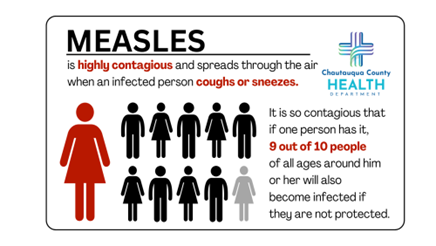
Measles is a highly contagious virus that lives in the nose and throat mucus of an infected person. It can spread to others through coughing and sneezing.
Contact with air droplets
If other people breathe the contaminated air or touch the infected surface, then touch their eyes, noses, or mouths, they can become infected. The virus can live for up to two hours in an airspace after an infected person leaves an area.
More facts about measles transmission:
- Measles virus can live for up to two hours in an airspace after an infected person leaves an area.
- It can spread to others through coughing and sneezing.
- If other people breathe the contaminated air or touch the infected surface, then touch their eyes, noses, or mouths, they can become infected.
- Your child can get measles just by being in a room where a person with measles has been, even up to 2 hours after that person has left.
- Animals do not get or spread measles.
How long is a person with measles contagious? |
A person with measles can pass it to others from 4 days before a rash appears through the 4th day after the rash appears.
All individuals who were exposed to measles and who do not know their vaccination status, are immunocompromised, or are pregnant should contact their health care provider immediately to discuss their situation.
Is there a treatment for measles? |
There is no treatment, but acetaminophen and ibuprofen may be taken to reduce a fever. People with measles also need bed rest and fluids. They also may need treatment for complications such as diarrhea, an ear infection or pneumonia.
Community Immunity |
Community immunity (also called herd immunity) occurs when enough people in a community are protected against a disease, through vaccination or previous infection, that it becomes much harder for the disease to spread. This helps protect everyone, including people who are not vaccinated or who have not been sick before.
Measles is extremely easy to catch and spreads easily through the air when an infected person coughs, sneezes or talks. About 95 out of 100 people in a community need to be immune to stop measles from spreading. People who are protected don’t spread measles as much as those who are not protected. If fewer than 95 out of 100 people are immune to measles, it spreads more easily. People who are not able to get the MMR (measles, mumps, rubella) vaccine, like infants under 6 months and pregnant people, are at greater risk of measles infection.
Why risk getting sick? Measles infection may mean you have lifelong protection against reinfection – but you first must suffer with symptoms like fever, rash, and swollen glands, and avoid or survive potentially deadly issues like brain swelling and pneumonia. The MMR vaccine also gives lifelong protection, and if you do get exposed after vaccination, you will have much milder symptoms.
More Resources |
- New York State Department of Health Measles Information
- CDC Measles Information
- American Academy of Pediatrics (AAP)
Printable Materials:
- Sept 2026 Immunization Clinic Flyer
- Oct 2026 Immunization Clinic Flyer
- Measles info sheet
- CDC info sheet
- Top 4 Things Parents Need to Know About Measles